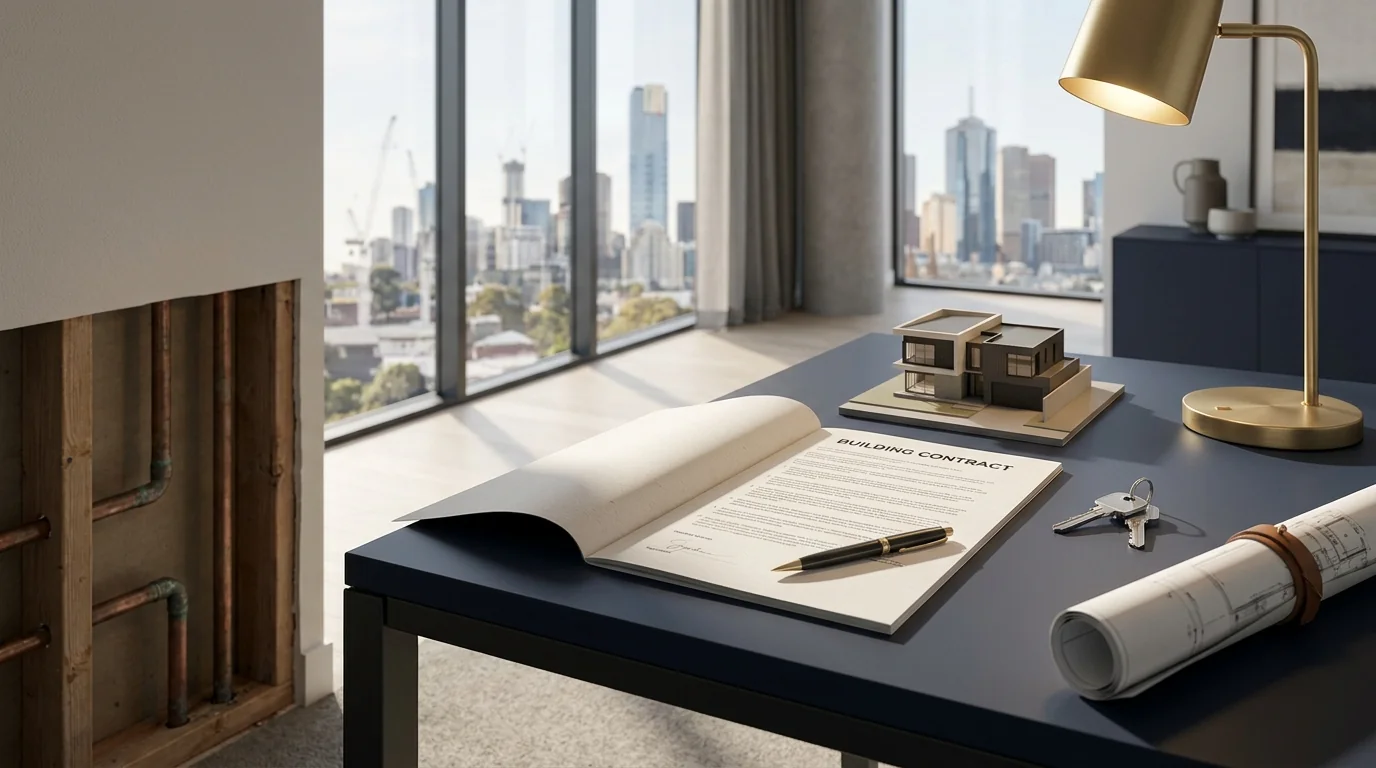
Most Victorian builders use either an HIA contract or an MBA building contract for residential projects over $10,000. Both comply with the Domestic Building Contracts Act 1995, and both contain terms that protect the builder more than the homeowner. The question is not which contract is “better” but rather which clauses in your specific contract need attention before you sign.
When we provide HIA and MBA building contract advice, we often see owners who assumed the contract was fair because it came from an industry body. That assumption can be costly. Industry associations represent their members (builders), and the contracts reflect this.
What Both Contracts Get Right
Both contracts deserve credit for including statutory protections. Both HIA and MBA contracts include the statutory protections required under Victorian law. You will find provisions covering domestic building insurance, the five business day cooling-off period, and the mandatory implied warranties. Progress payment schedules for fixed price contracts follow the percentages set out in the Act, unless the parties adopt a different schedule using the signed acknowledgment process the Act permits.
Both contracts also provide reasonable frameworks for practical completion, defects liability periods, and dispute resolution. They have evolved over many iterations to address common construction scenarios.
The problems lie not in what the contracts include, but in how certain provisions are drafted and what protections are missing.
Variations: A Leading Source of Disputes
If you only focus on one area during your HIA contract review, make it building variations. Variations are among the most common sources of building disputes, alongside defective work and payment claims.
Under the Domestic Building Contracts Act 1995, a builder who wishes to vary the plans or specifications must give you a written notice describing the variation and its effect on the contract price and completion date, and generally cannot proceed until you sign that notice. A limited exception applies where the variation does not require an amended building permit and will not add more than 2 per cent to the original contract price. If a builder carries out variation work without complying with these requirements, the builder cannot recover payment for that work unless VCAT is satisfied that exceptional circumstances exist or that the builder would suffer significant hardship, and that allowing recovery would not be unfair to you. The MBA contract similarly requires your written acceptance before variation work commences. This is a meaningful protection. Homeowners often have competing demands during construction, and missing a notice period can result in unauthorised costs.
Both contracts allow the builder to charge a margin on variation work. Look for the percentage stated in the contract particulars. Margins vary between projects, but the percentage applied can significantly affect the final cost. On a $50,000 variation, even a moderate margin could cost you thousands of dollars extra.
What to Negotiate
Ask for a clause requiring your written approval before any variation work starts. Request that all variation quotes include a breakdown of materials, labour, and margin. Consider capping the margin percentage for variations above a certain threshold.
Extension of Time Provisions
Both contracts permit the builder to claim extensions of time for delays outside their control. Weather, material shortages, and owner-caused delays are typical examples. This is fair enough. Builders cannot control every variable.
Where the contracts become less balanced is in the notice requirements. The HIA contract includes extension of time notice obligations under its specific clauses, but the consequences for failing to give notice are not clearly specified. The MBA contract has similar flexibility. Neither contract imposes strong consequences for a builder who fails to notify you promptly of delays.
In practice, some builders wait until the end of the project to claim all their extensions at once. By then, it is difficult to verify whether the claimed delays actually occurred or how long they lasted.
What to Negotiate
Add a clause requiring the builder to notify you within a set number of days (say, 5 business days) of becoming aware of any delay. Include a provision that failure to give timely notice limits or waives the extension claim.
How Each Contract Handles Defects
Both contracts include a defects liability period during which the builder must return to fix defects at their cost. The period is set out in the contract particulars and varies depending on the specific contract terms. However, many defects do not become apparent within a short defects liability period. Waterproofing issues, for example, might only surface after a year of seasonal weather.
The defects liability period is distinct from your right to enforce the statutory implied warranties. Those warranties arise under the Domestic Building Contracts Act, and a building action to enforce them must be brought within the 10-year limitation period under section 134 of the Building Act 1993, which runs from the issue of the occupancy permit or certificate of final inspection. You retain the right to pursue defect claims within that period, but after the defects liability period ends, enforcing those rights becomes more difficult and expensive. The builder is no longer contractually obliged to return to site; you may need to pursue a formal claim through VCAT or the courts.
What to Negotiate
Request an extension of the defects liability period to 12 months. This is common in commercial construction and increasingly acceptable in residential work for larger projects.
Liquidated Damages: Often Missing
Liquidated damages are pre-agreed daily amounts the builder pays if they fail to complete the work on time. Both standard form contracts include a space for liquidated damages in the contract particulars, but builders often leave this blank or insert “nil”. Check whether the edition you are given specifies a default rate where the item is left blank; where a default applies, it may be nominal.
Without liquidated damages, your remedy for delay is to prove your actual loss. This is difficult. You need to document rental costs, storage fees, or other expenses caused by the delay. If you were living with family or staying in the property during construction, quantifying loss becomes nearly impossible.
A reasonable liquidated damages figure provides a clear incentive for timely completion and avoids disputes about the extent of your loss.
What to Negotiate
Insert a liquidated damages amount. Calculate your likely daily costs if completion is delayed: temporary accommodation, additional rent, storage costs. Daily rates for residential projects can vary widely depending on your circumstances, so base the figure on your actual potential costs.
Identifying Unfair Terms in Building Contract Documents
Both HIA and MBA contracts contain provisions that, while technically permissible, may create unbalanced risk allocation. Some examples:
- Clauses allowing the builder to substitute materials “of equivalent quality” without requiring your consent
- Broad indemnity provisions requiring you to cover the builder’s losses arising from third party claims
- Limited liability caps that may not reflect the actual value at risk
- Clauses entitling the builder to suspend work if you raise a dispute about a progress claim
To identify unfair terms in building contract documents, you need to read beyond the front pages. The problematic clauses are often buried in general conditions that most owners never review carefully.
The Contract Is Only Part of the Picture
Your building contract works alongside other documents: the plans and specifications, engineering reports, and any protection works agreements. Inconsistencies between these documents create ambiguity that can work against you.
When we review building contracts, we look at the contract in context. The specifications might promise a particular brand of tap ware while the contract allows substitution. The plans might show a feature that is not included in the scope of works. These gaps can have significant consequences.
Getting the Terms Right Before You Sign
Both HIA and MBA contracts are negotiable. Builders sometimes suggest otherwise, but this is not accurate. The standard forms are starting points, not fixed documents. As with any contract, the parties can agree to amend the standard terms before signing.
The best time to request changes is before you sign. After you have signed, your ability to change terms largely disappears. A builder who wants your business will consider reasonable amendments. A builder who refuses to discuss any changes may be telling you something about how they will handle disputes during construction.
Note that Victorian domestic building contract law is undergoing reform. The Domestic Building Contracts Amendment Act 2025 received Royal Assent on 16 September 2025, and its key reforms will commence on a day to be proclaimed and no later than 1 December 2026. The reforms will move deposit limits and progress payment stages and limits into regulations, introduce a single process for variations, and make other changes to contract requirements. The reforms will apply only to contracts entered into on or after commencement, so you should check which regime applies to your contract before signing.
This information is general in nature. Contact us for advice specific to your situation.